
To the uninitiated, the Project Management Professional (PMP) credential is just a line on a resume—a grueling, four-hour exam survived once and filed away. But walk into the executive suites of tech giants in Seattle, defense contractors in Virginia, or healthcare networks in Boston, and you’ll find a different reality.
For senior project managers in the United States, passing the exam is merely the entry fee. The real power play happens every three years.
While average practitioners view the Project Management Institute’s (PMI) requirement of 60 Professional Development Units (PDUs) as a tedious administrative chore, elite senior leaders treat it as a masterclass in strategic positioning, executive networking, and personal branding. Here is how top-tier project leaders diligently maintain their credentials every 36 months—and weaponize that renewal to secure six-figure salaries, board seats, and recession-proof job security.
The PMP Renewal Cycle as an Executive Radar System
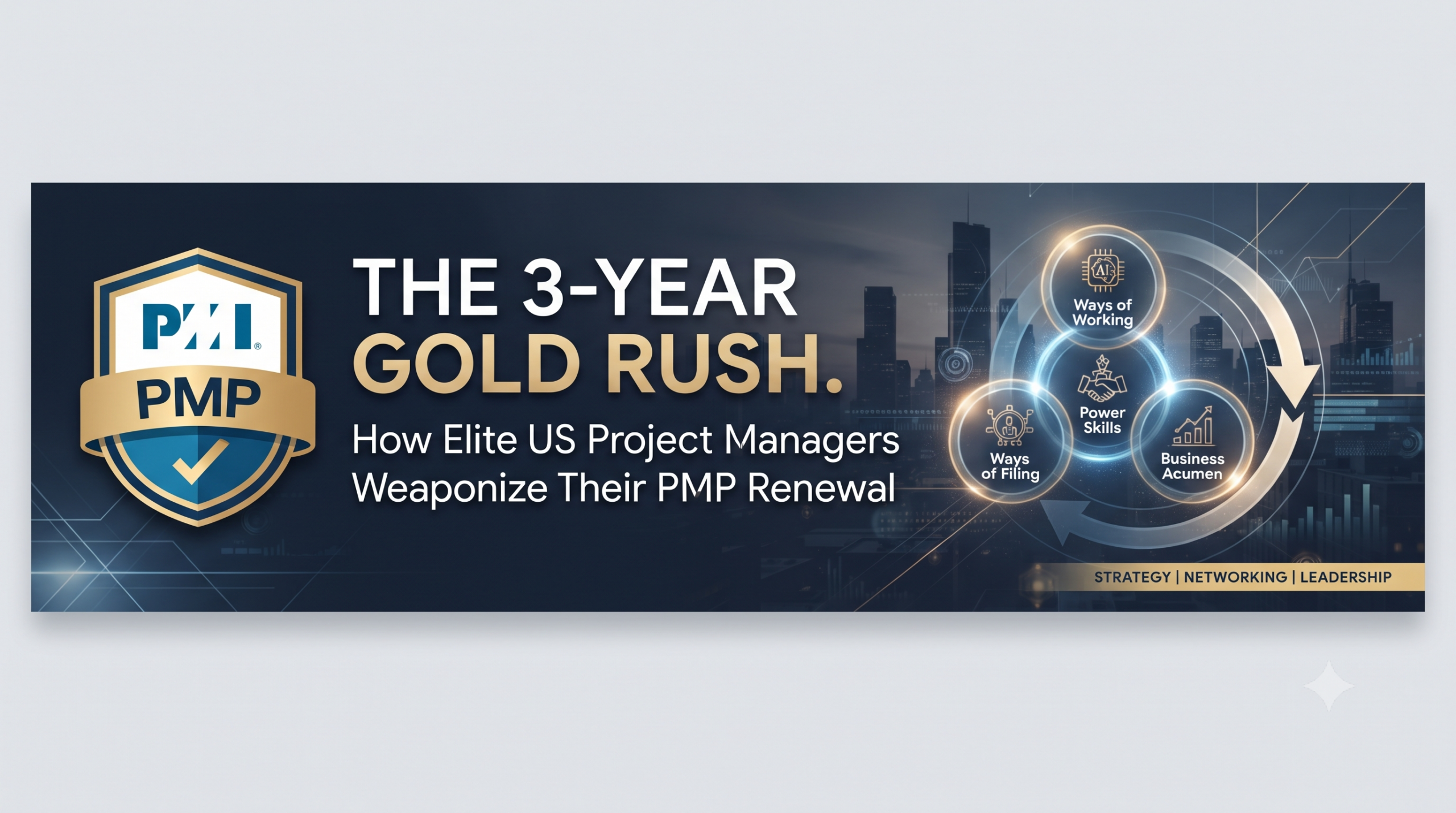
The corporate landscape shifts rapidly. Agile scaling frameworks, AI-driven resource allocation, and shifting macroeconomic risk profiles mean that what worked in project management in 2023 is obsolete today. PMI’s Talent Triangle—which mandates PDUs across Ways of Working (technical), Power Skills (leadership), and Business Acumen (strategic)—forces senior leaders to stay ahead of the curve.
Rather than cramming generic webinars at the eleventh hour, elite project managers use the 3-year Continuing Certification Requirements (CCR) cycle as an excuse to continuously upskill in high-value niches. By intentionally targeting courses in Generative AI project management governance, agile portfolio scaling, or executive financial stewardship, they ensure their skill sets remain bleeding-edge. When annual review season rolls around, their updated credentials act as concrete proof of modern, continuous competency.
Turning “Giving Back” Into Elite Networking
A brilliant loophole in the PMI renewal framework is the “Giving Back” category, which allows up to 25 PDUs per cycle through activities like mentoring, volunteering, or creating content. Senior project managers don’t see this as unpaid labor; they see it as high-level networking.
-
Mentoring Up and Out: By mentoring mid-level managers or aspiring PMPs, senior leaders build internal talent pipelines and cement their reputation as natural organizational leaders.
-
Chapter Leadership & Panels: Speaking at local PMI chapter events or industry panels earns massive blocks of leadership PDUs while placing them directly in front of executive recruiters and C-suite decision-makers looking for talent.
The Resume Psychology: The Power of Active Status
In the competitive US job market, algorithms and human recruiters alike scan for active certifications. Letting a PMP lapse into suspension signals stagnation. Conversely, a cleanly maintained history of continuous certification communicates reliability, discipline, and an obsession with professional excellence.
When negotiation time arrives, PMP holders command a measurable salary premium—often earning significantly more than their non-certified counterparts. For a senior manager, the nominal cost of renewal ($60 for PMI members vs. $150 for non-members) yields an exponential return on investment, acting as an infallible shield during corporate downsizing and a springboard for promotions to Director, VP, or Portfolio Manager.
The PMP isn’t a badge of what you achieved three years ago; it is a public declaration of what you are learning today. For more detailed information, Call us at +919901854125